
InventoryLast updated on May 4, 202614 min read

Steel Pipe Inventory Chaos: 5 Problems Costing You Lakhs Monthly (And How to Fix Them)

A medium steel pipe business in Pakistan loses PKR 6 to 8 crore a year to ghost inventory, stockouts, location chaos and multi-branch blindness. We pulled the five most common problems off the floors of Lahore, Karachi and Faisalabad and wrote down the fix for each.

PT
Written by
Pipetal Team
ZA
Reviewed and Fact-Checked by
Zain Ali
Co-Founder & CTO

Why you can trust our content

Hands-on engineering team that has been deploying ERP at Pakistani factories since 2020

First-hand mill-floor data from 50+ steel manufacturers across Lahore, Gujranwala and Karachi

Verified standards from trusted sources like FBR, Pakistan Steel Manufacturers Association, and Statista

Take action
Let's Work Together
Book Free Discovery Call

Your warehouse manager calls at 2 AM. “Sir, we promised 500 pieces of 4-inch ERW pipes for tomorrow. We only have 180. Records show 520.”

This is not bad luck. It is bad inventory management.

Pakistani steel pipe manufacturers lose PKR 6 to 8 crore annually to inventory mismanagement. That is 15 to 20 percent of revenue vanishing, enough to buy new machinery or open another branch. Most owners do not realise the damage until it is too late.

As Pakistan’s first steel pipe industry-specific ERP provider, we have seen the same five problems destroy businesses across Lahore, Karachi and Faisalabad. Let us fix them.

A medium steel pipe business in Pakistan loses PKR 6 to 8 crore a year to inventory chaos. That is 15 to 20 percent of revenue, enough to buy new machinery or open another branch.
Zain Ali·Co-Founder & CTO

Key Information Summary for Steel Pipe Inventory

  • Problem 1. Ghost inventory
    Manual counting, hidden damage and petty theft create stock that exists on paper but not in the yard. A 3 percent gap on PKR 5 crore stock is PKR 15 lakh of dead capital.
  • Problem 2. Zero heat traceability
    Without coil-to-pipe documentation you cannot defend warranty claims, win PSQCA-grade contracts or isolate defective batches.
  • Problem 3. Overstocking-stockout paradox
    Fear-based buying locks PKR 4 crore in slow-moving coils while you stock out of bestsellers because no demand forecast is in place.
  • Problem 4. Warehouse location chaos
    200+ pipe varieties scattered across yards with no bin system turn 5-minute retrievals into 2-hour searches.
  • Problem 5. Multi-branch blindness
    Lahore buys at a premium while Karachi has the same SKU sitting idle. Group inventory bloats by 30 percent.
  • What this costs you
    A medium PKR 50 crore business loses PKR 6.8 crore a year, 13.6 percent of revenue, to these five issues combined.
  • The solution
    An industry-specific ERP unifies pipe specs, heat numbers, multi-location stock, AI forecasting and Pakistani compliance in one system.
  • Real results
    A Lahore plus Karachi manufacturer dropped shrinkage from 4 percent to 0.8 percent and won a PKR 2 crore contract on traceability alone.
  • Your next step
    A free 60-minute inventory assessment shows your exact annual loss and a customised fix roadmap.

Stop the inventory bleed today

Book Free Discovery Call

Problem 1. Ghost inventory (stock that does not exist)

Your Excel says 500 pipes. Your warehouse has 320. Your accounts show 480. Nobody knows the truth.

Ghost inventory creeps in through tired workers counting the same stack twice, unreported damages where a forklift mangles 30 pipes and the worker hides the loss, weekly small theft that compounds into thousands of pieces by year-end, and a sales team selling 200 pipes this morning while production plans against yesterday’s data.

  • Manual counting errors compound stack by stack
  • Forklift damage gets quietly written off the floor
  • Petty theft of a few pieces a week becomes a year-end disaster
  • No real-time updates means sales and production work off different numbers

Pakistani Reality: managing 50+ pipe varieties across multiple cities on Excel is a recipe for disaster. A 3 percent inventory discrepancy on PKR 5 crore stock equals PKR 15 lakh of ghost inventory draining your capital, before anyone notices.

The numbers
  • Lost contract valuePKR 25 lakh
  • Emergency purchase premiumPKR 3.2 lakh
  • Total damage from one incidentPKR 5+ lakh

Problem 2. Zero heat traceability

A customer calls. “The pipes you supplied have cracks. Show us the heat number, coil source and test certificates.”

Panic. No idea which batch, which coil, which specifications. Heat traceability is not a paperwork exercise. It is the proof that decides whether you keep a contract or lose two crores.

Without traceability you cannot isolate defective batches, you cannot satisfy major-project compliance, you cannot defend a warranty claim, and you cannot hold your own supplier responsible when their material was substandard.

Pakistani Context: PSQCA compliance is increasingly mandatory for public projects. Export buyers demand full traceability. CPEC and major government contracts will not even accept your bid without proper coil-to-pipe documentation.

The numbers
  • Pipes rejectedPKR 18 lakh
  • Annual contract cancelledPKR 2 crore
  • Reputation in construction sectorDestroyed

Problem 3. The overstocking-stockout paradox

You have PKR 5 crore of slow-moving coils rusting in your yard, yet you run out of your best-selling 2-inch GI pipes three times a month. Simultaneously overstocked and understocked.

It happens because purchasing runs on fear, not data. “What if we run out?” leads to extra orders, then extra orders on top of those. A 5 percent bulk discount on 500 tons sounds great until PKR 4 crore is locked for eight months. Seasonal blindness compounds the problem when buyers order the same quantity year-round despite the March-to-June construction rush, the post-Eid spike and the November-to-February peak.

  • Fear-based buying with no demand forecast
  • Bulk discount traps that lock up working capital
  • Same monthly order quantity ignoring seasonal demand
  • No supplier lead-time tracking baked into reorder points

Pakistani Seasonal Patterns: pre-monsoon construction rush drives demand up 40 percent in March-June, Ramadan slows then spikes post-Eid, PSDP project cycles create surges, and November-February peaks for winter construction. Ordering the same quantity every month guarantees pain.

The numbers
  • Capital blocked annuallyPKR 81 lakh interest
  • Stockout customer lifetime value lostPKR 40 lakh
  • Overstocking total annual costPKR 1.38 crore

Problem 4. Warehouse location chaos

“Go find the 4-inch seamless ASTM A106 bundle from last week.” Two hours later, the worker is still searching your 5-acre yard. Customer’s truck waiting. Dispatcher anxious. Salesperson calling every 10 minutes.

No location system, 200+ pipe types scattered randomly, forklift movements never logged, multiple yards and sheds and old godowns each with their own logic, and shifts storing in different sections without coordination. Nobody knows where anything is unless they personally put it there last week.

  • No bin or rack location system across the yard
  • Forklift moves and rack transfers never logged
  • Outdoor yards, covered sheds and old godowns operating independently
  • Day shift stores in Section A, night shift in Section C, no coordination

One manufacturer purchased PKR 15 lakh of pipes they already owned but could not find. They discovered the duplicate stock six months later during physical count. That is not an inventory problem, that is a location problem.

The numbers
  • Search time per incident2 workers x 2 hours
  • Wasted labour per monthPKR 40,000
  • Annual search-time wastePKR 4.8 lakh

Problem 5. Multi-branch blindness

Lahore branch buys emergency stock at a premium. Karachi branch has excess of the same item sitting idle. Nobody knows. Two separate Excel files, no real-time sync, WhatsApp coordination instead of a system.

When each branch keeps its own records and updates on its own schedule, you lose every economy of scale. Branches negotiate separately and miss volume discounts. Customers hear “sorry, not in Lahore” while the same SKU sits in Karachi. Group inventory that could run with PKR 9 crore is bloated to PKR 12 crore.

  • Each branch maintains its own records on its own schedule
  • No real-time sync across locations
  • No group-wide visibility for the owner or finance head
  • WhatsApp groups standing in for an actual operations system

A Lahore-Karachi pair routinely loses PKR 3.2 lakh a month, that is PKR 38 lakh annually, simply because emergency purchases cost a premium when transfers between branches would have cost PKR 50,000.

What this costs you (the total damage)

For a medium steel pipe business with PKR 50 crore revenue and PKR 8 crore inventory, the annual loss adds up fast.

That is 13.6 percent of revenue disappearing every year. Enough to buy a complete new production line or expand into two new cities.

The numbers
  • Ghost inventory (3 percent)PKR 24 lakh
  • No traceability, lost contractsPKR 40 lakh
  • Overstocking holding costsPKR 43 lakh
  • Stockouts (5 percent lost sales)PKR 2.5 crore
  • Emergency purchasesPKR 80 lakh
  • Location search wastePKR 5 lakh
  • Multi-branch inefficiencyPKR 38 lakh
  • Total annual lossPKR 6.8 crore

The solution: industry-specific ERP

Generic software does not understand steel pipes. You need a system built for pipe specifications (OD, wall thickness, grade, length, coating), heat traceability from coil to customer, multi-dimensional inventory by size, specification, location and heat number, Pakistani compliance (FBR, PSQCA, ASTM, API), and real-time multi-location visibility.

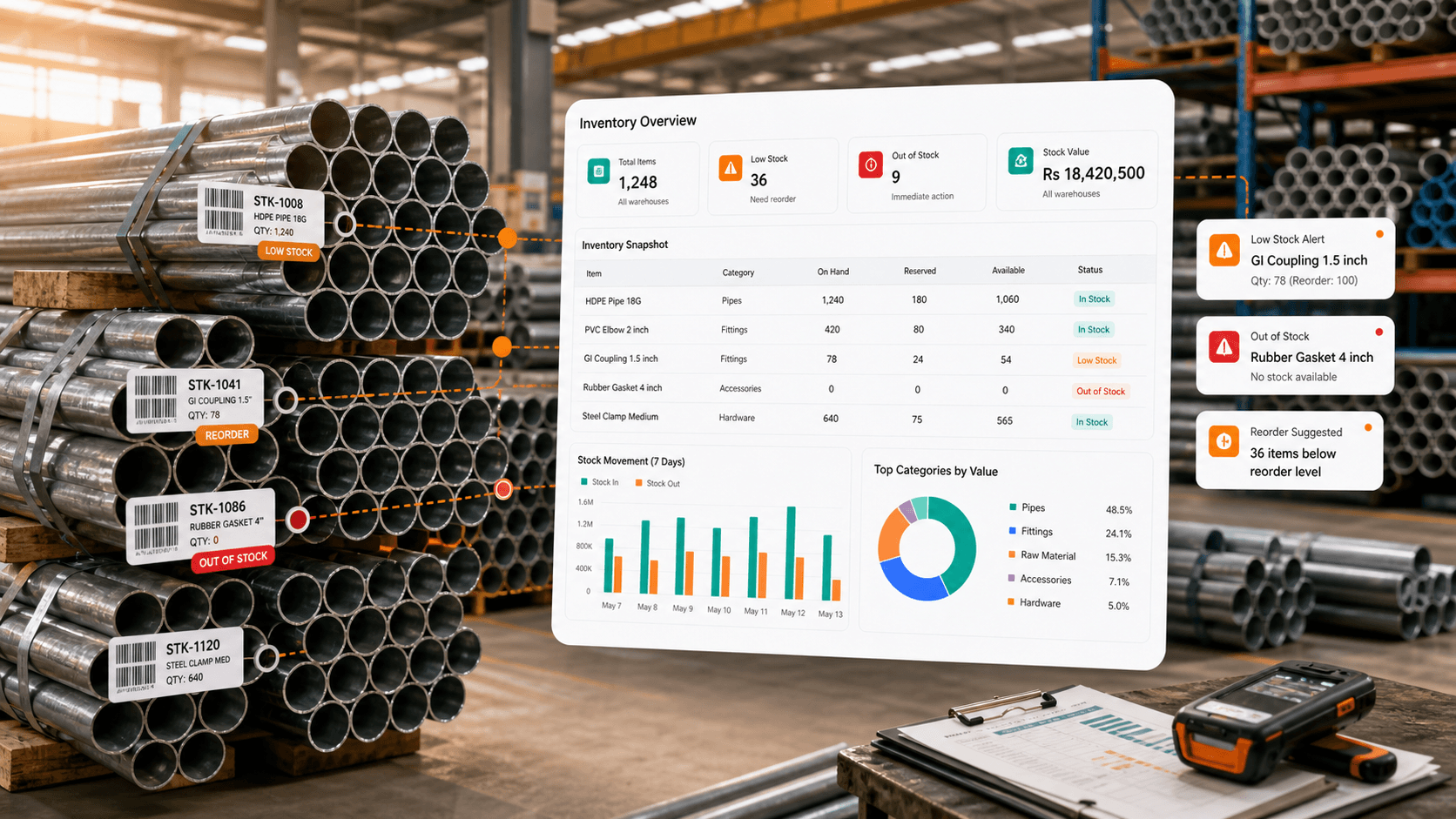
That is exactly the problem Pipetal was built to solve. Every transaction updates instantly through web and mobile apps. Coil-to-customer traceability is automatic, not a side project. AI-driven forecasting accounts for the seasonal rhythms of the Pakistani construction calendar. Bin-level location mapping turns 2-hour searches into 5-minute retrievals. And multi-branch transfers, approvals and consolidated reporting make group-level decision-making possible from a phone.

  • Real-time control across web and mobile, no manual entry lag
  • Coil-to-customer traceability with digital MTR storage
  • Smart inventory with AI forecasting and seasonal adjustments
  • Centralised multi-branch visibility with inter-branch transfers
  • Bin-mapped warehouses with barcode scanning and guided picking

Real results from a Lahore + Karachi manufacturer

A medium ERW manufacturer running operations in Lahore and Karachi (name withheld) was burning 4 percent shrinkage annually, hitting 5 to 6 stockouts a month, and losing 3 hours a day to yard searches. Heat traceability was zero. The two branches functioned like two different companies.

Six months after going live with Pipetal, shrinkage dropped to 0.8 percent (PKR 96 lakh saved), stockouts fell to 0 to 1 a month, search time collapsed from 3 hours to 8 minutes, traceability hit 100 percent, and a PKR 2 crore government contract was won purely because the bid included full coil-to-pipe documentation. Inter-branch duplicate purchases were eliminated, saving another PKR 15 lakh.

The numbers
  • Annual benefitPKR 6+ crore
  • ROILess than 2 months
  • Stockouts per month5-6 to 0-1
  • Search time3 hours to 8 minutes

Your next step

Every day you delay costs money. PKR 6.8 crore annual loss divided by 365 days equals PKR 1.86 lakh per day. While you were reading this article, your business probably lost a few thousand to inventory chaos.

We offer a free 60-minute inventory assessment, worth PKR 50,000, that walks through your current process, calculates your exact annual loss, builds a customised improvement roadmap and gives you a live Pipetal demo. No obligation, no quotation pressure.

Questions

Frequently asked

Most clients hit ROI in 2 to 6 months. Typical monthly cost is meaningfully less than what you are currently losing to inventory leakage. Contact us for a customised quote based on your factory size and module mix.

Two to four weeks end-to-end including data migration and team training. We have done it faster on focused single-branch deployments and slower on multi-branch group rollouts that need stage-gating.

Yes. Pipetal was designed for Pakistani factory teams. The interface is simple, the screens are in plain language, training is comprehensive and most users are comfortable inside two weeks.

Pipetal is highly customisable. The platform is pre-configured for steel pipes (heat numbers, OD/WT/grade, ERW vs seamless vs galvanised) and we tailor the rest of the workflow to how your factory actually operates.

Phone, WhatsApp, email and remote support, with response times measured in hours not days. Our team is in Pakistan, speaks the language and understands the industry.

Conclusion

The bottom line

Five inventory problems are quietly destroying Pakistani steel pipe businesses: ghost inventory draining capital, zero traceability killing contracts, the overstocking-stockout paradox locking up working capital, location chaos wasting hours daily, and multi-branch blindness duplicating costs.

The combined cost is PKR 6 to 8 crore annually for a medium business. The solution exists. The technology is proven. The ROI is fast. Your competitors are already using modern systems and your customers expect reliability and traceability.

Do not let inventory chaos cap your growth. Pakistan’s steel pipe industry is booming. Make sure you are not leaving crores on the table.

Ready to plug the inventory leak?

Book a free 15-minute discovery call. Bring your hardest reporting question, your messiest workflow, your toughest yard or attendance problem. We will show you the screen.

Book a free discovery call