
HR & PayrollLast updated on May 4, 202613 min read

5 Ways Workers Cheat Biometric Attendance (And How to Stop It)

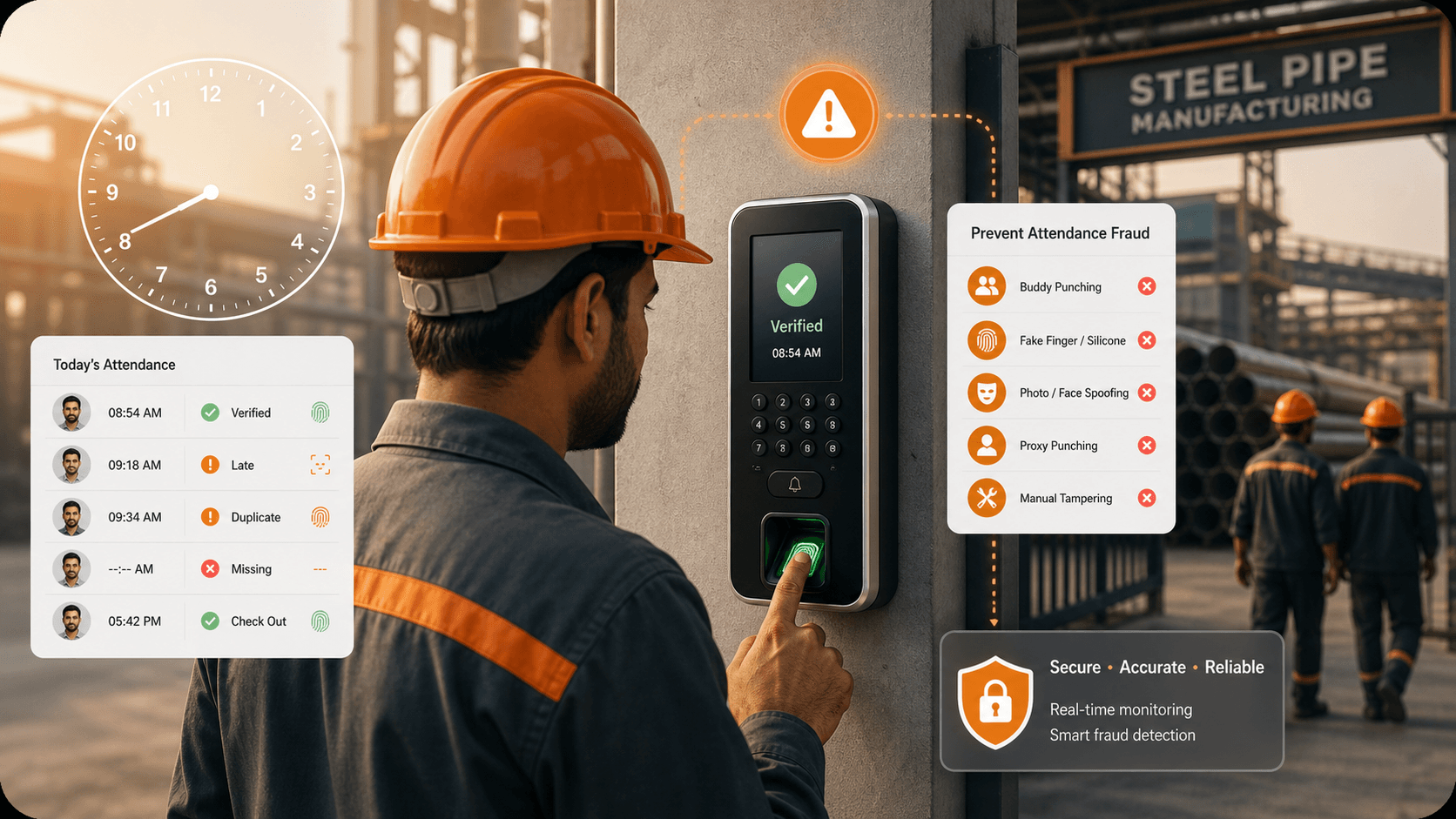
You installed a PKR 3 lakh biometric system and assumed attendance fraud was impossible. It is not. Here are the four ways factory workers in Pakistan cheat fingerprint and face devices every month, and the system controls that actually stop the leakage.

PT
Written by
Pipetal Team
ZA
Reviewed and Fact-Checked by
Zain Ali
Co-Founder & CTO

Why you can trust our content

Hands-on engineering team that has been deploying ERP at Pakistani factories since 2020

First-hand mill-floor data from 50+ steel manufacturers across Lahore, Gujranwala and Karachi

Verified standards from trusted sources like FBR, Pakistan Steel Manufacturers Association, and Statista

Take action
Let's Work Together
Book Free Discovery Call

You installed a PKR 3 lakh biometric system. You think attendance fraud is impossible now. Think again.

Last month, a Faisalabad steel manufacturer discovered they had paid for 180 hours of work that never happened. Their “foolproof” biometric system was being cheated daily. The damage was PKR 4.2 lakh in one month alone.

Biometric attendance fraud is Pakistan’s silent profit killer. Even sophisticated fingerprint and face systems have loopholes that employees, supervisors and HR clerks exploit. For a 100-employee factory, attendance fraud costs PKR 2 to 5 lakh monthly, that is PKR 24 to 60 lakh annually, enough to buy new machinery or hire 15 more workers.

Let us expose how it is actually happening, and how to stop it.

A standalone biometric device only solves identity at the moment of punch. The other four leaks (fake OT, supervisor collusion, manual edits, no audit trail) cost a 100-employee factory PKR 82 lakh a year.
Zain Ali·Co-Founder & CTO

Key Information Summary for Biometric Fraud

  • Why attendance matters
    Labour is 30 to 40 percent of manufacturing cost. A 10 percent fraud rate hits production targets, quality and EOBI compliance, not just wages.
  • Fraud method 1. Buddy punching
    Older devices are fooled by photos, gel prints and pre-supervisor collusion. Costs about PKR 9.6 lakh a year for 10 employees.
  • Fraud method 2. Fake overtime inflation
    Workers mark in early or out late without working those hours. Five workers inflating OT cost PKR 60 lakh a year.
  • Fraud method 3. Supervisor-worker collusion
    Friday-only “setting” arrangements and group cover-ups quietly steal PKR 3.6 lakh a year.
  • Fraud method 4. Leave and record manipulation
    Clerks with edit rights flip absences to paid leave and adjust leave balances, costing PKR 9.6 lakh a year.
  • Total damage
    A 100-employee factory loses PKR 6.9 lakh a month, PKR 82+ lakh a year, plus best-worker churn and quality defects.
  • Why standalone biometrics fail
    The device only verifies identity at punch. No production cross-check, no anomaly alert, no audit trail.
  • The fix. Integrated attendance
    Photo plus fingerprint, OT linked to work orders, multi-level approvals and tamper-proof audit trail close every leak.
  • Implementation
    Announce, train, give a 30-day grace period, then enforce strictly and reward perfect attendance publicly.

Stop paying for ghost workers today

Book Free Discovery Call

Why attendance matters (it is not just wages)

Labour cost is 30 to 40 percent of manufacturing costs. A 10 percent attendance fraud rate equals 3 to 4 percent total cost increase, hitting your bottom line directly.

But the money is only half the damage. Production planning fails when you plan for 100 workers and only 85 actually work. Quality suffers because tired workers doing fake overtime cut corners. Honest employees get demoralised when they see fraud rewarded. EOBI contributions are inflated by ghost attendance and labour department inspections expose the gaps.

  • Production plans miss targets when actual headcount is below planned
  • Defect rates rise when workers fake long shifts they never worked
  • Best employees leave, frustrated by tolerated cheating
  • Inflated EOBI and tax filings create labour-department audit risk

Fraud method 1. Buddy punching (friend marking)

Employee A marks attendance for absent Employee B. The most common fraud in Pakistani factories. “Yaar log in kar do, late ho gaya.”

Older biometric devices have weak fingerprint quality checks. They can be fooled with photos of fingerprints, tape and glue impressions or gel-based fake prints. Or just simple collusion: Employee A arrives at 8 AM, marks for B who shows up at 10. The supervisor has not arrived yet, nobody notices. The device captures a fingerprint but no face, so there is no proof of who actually punched.

  • Older devices fooled by photos, tape impressions and gel prints
  • Simple before-supervisor-arrives collusion
  • No face capture means no proof of who actually punched
  • Trust culture (cousin, family, clan) means nobody cross-checks

Pakistani Reality: trust culture works against you here. “He is my cousin, he would not cheat.” Biometric data is never verified against actual physical presence on the floor, supervisors do not cross-check, and the weakest device check becomes the company-wide standard.

The numbers
  • 10 employees x 2 hours stolen, twice a week160 hours/month
  • At PKR 500/hourPKR 80,000/month
  • Annual loss from this method alonePKR 9.6 lakh

Fraud method 2. Fake overtime inflation

Employees mark entry and exit to create false overtime hours without actually working those hours.

The mechanics are straightforward. Mark in at 6 AM (official start 8 AM) and claim 2 hours of OT. Actually arrive at 7:45 AM, go for chai, come back at start time. Or mark out at 8 PM (official end 5 PM) for 3 hours of OT but actually leave at 5:15 PM after spending the rest in the canteen, sleeping in the car or going home. The “perfect crime” is to mark in early, leave the premises, return for the actual shift, mark out late and immediately leave, all while claiming 4 to 5 hours of daily OT.

It works because OT approval is based on attendance data alone, not actual output. Production supervisors are not in the OT approval loop. The system never flags unusual patterns like the same worker always marking in 2 hours early.

  • Mark in early, then leave the premises until real shift starts
  • Mark out late, then leave the premises immediately
  • OT approval gated on attendance, not output
  • Production supervisor not in the OT chain at all
The numbers
  • 4 false OT hours daily x PKR 1,000/hr OT ratePKR 4,000/day
  • 25 working daysPKR 1 lakh/month
  • Annual loss from ONE workerPKR 12 lakh
  • If 5 workers do thisPKR 60 lakh annually

Fraud method 3. Supervisor-worker collusion

Supervisor and workers reach an informal arrangement. Workers take unauthorised breaks, supervisor adjusts records or allows buddy punching, money or favours change hands.

A typical deal: workers pay the supervisor PKR 500 to 1,000 weekly. In exchange the supervisor allows late arrivals, early exits and buddy punching, or the workers do the supervisor’s personal errands. Group collusion takes it further. The whole shift covers for each other, the supervisor marks everyone present, workers rotate days off, and production still gets met because the workers actually present compensate.

It is hard to detect because the biometric data looks normal, production targets get hit, and only detailed pattern analysis reveals the rotation. The Friday afternoon scenario is classic: 5 workers leave at 2 PM for Jummah, do not return, supervisor marks exit at 5 PM, workers each pay PKR 500. Supervisor pockets PKR 2,500 a Friday, workers get 3 paid hours off.

Pakistani Context: relationship culture and “setting” arrangements make this fraud extremely common. Supervisors protect their own people. Loyalty trumps rules. Without an automated multi-level approval workflow and a tamper-proof audit trail, you will never see it from the owner’s desk.

The numbers
  • Friday-only collusion, 4 weeks60 hours/month
  • At PKR 500/hourPKR 30,000/month
  • Annual Friday-only lossPKR 3.6 lakh

Fraud method 4. Leave and record manipulation

Attendance records get altered after the fact. Unauthorised absences become authorised leave. Records are tampered.

If the system allows manual editing, a clerk who is the worker’s relative converts 5 unauthorised absences to “sick leave with pay” with no approval, no verification. Half-day manipulation is similar: came late, worked half a day, marked as full-day present, manager misses it in monthly data. Leave balance fraud goes deeper, the system shows 2 leaves remaining, the worker actually took 8 this year, somebody with backend access adjusted the balance.

  • Clerks with edit rights silently flip absences to paid leave
  • Half-day work logged as full-day present
  • Leave balances quietly adjusted after the worker has overrun their quota
  • No approval workflow, no audit trail, no flag
The numbers
  • 20 workers x 2 days/month x PKR 2,000/dayPKR 80,000/month
  • Annual lossPKR 9.6 lakh

Total damage: what attendance fraud actually costs

Add it up for a typical 100-employee Pakistani steel pipe factory and the numbers stop being abstract.

PKR 6.9 lakh a month. PKR 82 lakh a year. And that is before the hidden costs: best workers leaving, planning errors, quality defects from fake-OT fatigue, and the competitive disadvantage of running with bloated payroll while your tighter-controlled competitor wins on price.

The numbers
  • Buddy punching (10 employees)PKR 80,000/month
  • Fake OT (5 employees)PKR 5 lakh/month
  • Supervisor collusionPKR 30,000/month
  • Leave manipulation (20 employees)PKR 80,000/month
  • Total monthly lossPKR 6.9 lakh
  • Annual lossPKR 82+ lakh

Why standalone biometric devices fail

Your PKR 3 lakh biometric investment is not stopping fraud because the device alone solves only one problem (identity verification at the moment of punch) and leaves the other four problems wide open.

The data sits inside the device. Somebody manually exports it to Excel. Excel is trivially manipulable. There is no real-time monitoring, no production cross-check, no supervisor verification, no pattern detection, no anomaly alert and no audit trail. The device just records attendance, it does not analyse it.

  • Standalone data is exported to Excel and silently edited
  • No verification that the person actually stayed after marking
  • No production-output cross-check on claimed hours
  • No pattern detection (always 2 hours early? Why?)
  • No audit trail of who changed what, when, why

The fix: integrated, intelligent attendance management

Pipetal’s HR & Payroll module plugs directly into ZKTeco fingerprint and face devices, and cloud-based ZKBioTime. The device is no longer the system, it is just a sensor feeding the system.

Photo verification at the moment of punch eliminates buddy punching because face plus fingerprint must match. OT approvals require a production supervisor sign-off tied to actual work orders, killing fake-OT inflation. Multi-level approval workflows make supervisor-worker collusion visible from the management dashboard. Manual edits are not deletes, they are logged with who, what, when and why, so the audit trail is tamper-proof. Real-time alerts flag unusual patterns the moment they appear, not 30 days later in payroll.

  • Face plus fingerprint verification stops buddy punching
  • OT linked to production orders, not just attendance hours
  • Multi-level approval workflow visible to management
  • Tamper-proof audit trail for every record change
  • Real-time anomaly alerts to supervisors and owners
  • Excessive-OT cap settings enforced automatically

A real Faisalabad turnaround

A 120-employee Faisalabad steel factory running 3 shifts had standalone biometric plus Excel and a PKR 48 lakh monthly payroll. They suspected fraud but could not prove it.

In the first month after Pipetal HR went live, the system surfaced 18 instances of buddy punching (caught by photo verification), 12 employees routinely claiming 2+ hours of false OT, and supervisor-worker collusion in the night shift. The owner used a 30-day grace period with warnings and clear rules instead of immediate action.

After six months, monthly wage leakage dropped by PKR 3.2 lakh, on-time attendance rose from 72 to 91 percent, OT hours fell 35 percent without any drop in production, and honest employees were visibly happier because the cheating they always knew about had finally stopped.

The numbers
  • Monthly wage leakage eliminatedPKR 3.2 lakh
  • On-time attendance72% to 91%
  • OT hours reduced35%
  • Annual savingsPKR 38.4 lakh
  • ROI2 months

Implementation: how to roll this out without a mutiny

The wrong way is to ambush the staff. Workers will revolt, supervisors will sabotage and honest employees will get caught in the crossfire. The right way is to announce transparently, train everyone, start with warnings, then enforce strictly.

Step 1, announce that the new system is here to protect honest workers. Step 2, train every shift on what is acceptable, what is not, and what the consequences are. Step 3, give a 30-day grace period where the system flags but does not penalise. Step 4, after the grace period, enforce consistently with no exceptions. Step 5, reward perfect attendance publicly so the culture starts pulling honest workers up rather than dragging everyone down.

Questions

Frequently asked

Honest employees love it. They have been carrying the slack for cheating colleagues for years. Explain it that way, that the system protects them by ending the unfairness, and resistance evaporates.

The system supports supervisor-approved exceptions with a documented reason. Real emergencies stay handled. What goes away is the silent backdoor.

Biometric integration alone is 2 to 3 days. The full HR module including payroll, leave management and approval flows is 2 weeks end-to-end including training.

Monthly savings typically run 5 to 10 times the system cost. Most factories hit ROI inside 2 months.

Pipetal integrates with most ZKTeco devices (USB, network, cloud) plus ZKBioTime. We verify compatibility on the discovery call before any commitment.

Conclusion

The bottom line

Four ways employees cheat biometric systems: buddy punching (PKR 80,000/month), fake overtime (PKR 5 lakh/month), supervisor-worker collusion (PKR 30,000/month) and record manipulation (PKR 80,000/month). Total monthly loss for a 100-employee factory is PKR 6.9 lakh, annually PKR 82+ lakh.

Standalone biometric devices are not enough. You need integrated, intelligent attendance management with photo verification, production-linked OT, real-time alerts, approval workflows and built-in fraud-detection analytics.

Stop paying for work that never happened. Pakistani manufacturing is competitive. Do not give away lakhs to attendance fraud.

Ready to stop paying for ghost workers?

Book a free 15-minute discovery call. Bring your hardest reporting question, your messiest workflow, your toughest yard or attendance problem. We will show you the screen.

Book a free discovery call